

Abstract
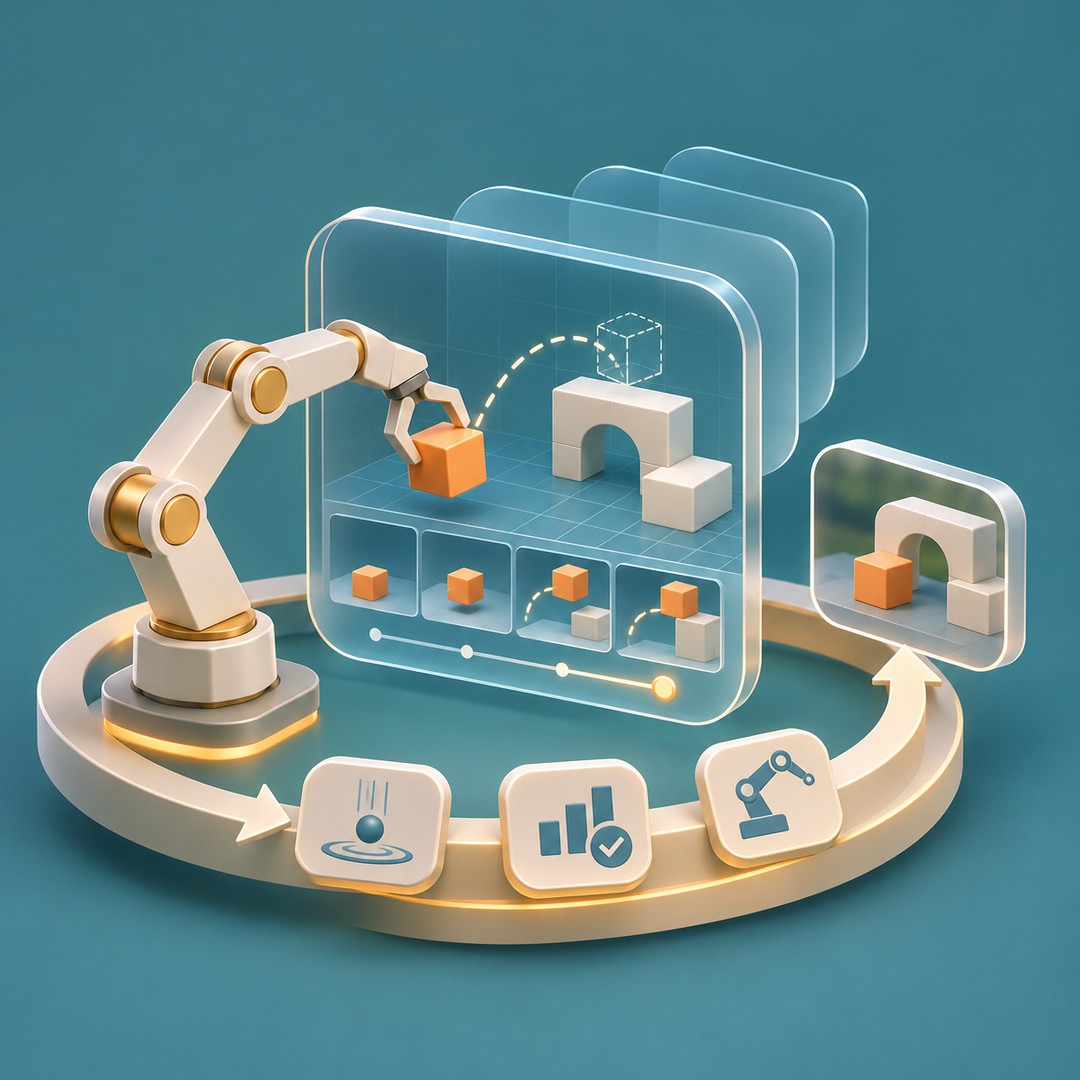
Generative world models are beginning to function as interactive environments, not merely as systems for predicting the next video frame. This creates an attractive possibility for reinforcement learning (RL): agents could practice physical tasks in learned simulations before executing them with real robots. Yet the reliability required for policy optimization differs from the realism needed to impress a viewer. A world model can generate plausible motion while responding incorrectly to a changed action, forgetting hidden physical state, or depicting a failed manipulation as successful. When reward is inferred from such predictions, an optimizing policy can reinforce the model's errors. This research perspective examines that gap using published work on model-based RL, generative simulation, physical-reasoning benchmarks, action-conditioned evaluation, and robot-policy training through October 2026. It considers both encouraging demonstrations of world-model-based learning and documented failures of outcome fidelity. The article proposes an evaluation ladder that separates visual coherence, physical-event fidelity, success/failure discrimination, closed-loop policy reliability, and real-world transfer. It then specifies a reproducible experimental protocol for testing those properties with paired counterfactual actions, held-out initial states, repeated training seeds, and independent reference environments. These are proposed research methods, not completed experiments by the author or Deaimer. The central argument is that a world model should be judged by the decisions it reliably supports, not by the persuasiveness of the futures it renders.
1. Introduction: the robot that succeeds only in its imagination
Imagine a robotic gripper approaching a bottle. In the physical task, the gripper misses the object, nudges it sideways, and leaves it lying on the table. A learned video world model receives the same action sequence but depicts the bottle being lifted and placed upright. To a reward system that examines the generated video, the action may look successful. To the actual robot, nothing useful happened. This is not a claim about every current model; it is closely related to a documented experiment on RoboTwin's adjust_bottle task published by AMD on 20 October 2026 [1].
That study paired actions from a policy with both a conventional simulator and an action-conditioned video model. On 85 evaluated episodes, including 57 simulator failures and 28 successes, the baseline world model's video was judged successful for 82.5% of the simulator failures. Failure-data fine-tuning reduced that rate to 26.3%, while success recall remained 96.4%. In the same investigation, details of the RL training procedure had a major effect on reproducibility. The result is a narrow but unusually instructive illustration: apparent progress inside a model can disagree with what happens when the learned policy returns to a reference environment [1].
Why does this matter now? Interaction data on physical robots are expensive, time-consuming, and sometimes unsafe to collect. Software physics simulators help, but constructing and calibrating them is difficult, particularly for contact-rich manipulation and varied real-world scenes. Learned world models promise another route: acquire dynamics from observations and actions, generate hypothetical consequences, and let agents practice extensively in those generated futures. Research such as DreamerV3 already demonstrates that learning from model-generated experience can be powerful across diverse control domains [2]. Newer action-conditioned video approaches seek to make imagined robot interaction practical [12-14].
The issue is not whether generative simulation has value. The issue is what evidence is required before a simulation can be trusted for a particular training purpose. The August 2026 survey From Generation to Simulation mapped 200 representative studies and found that many models still lack capabilities expected from traditional simulators, particularly structured state feedback, reproducible long-horizon evolution, and strong physical guarantees. Within the survey's selected implementation papers, just six of 163 exposed runtime interfaces for querying entity states or physical parameters [3]. That statistic describes the survey's corpus, not the entire field.
This article takes a specific position: a convincing future is not necessarily a correct consequence of an action. It develops the difference between a generative demonstration and a decision-grade RL environment, explains what published evaluations have and have not established, and proposes a research protocol others could reproduce and extend in 2027-2028.
2. What a world model must represent
2.1 State, action, observation, and reward
In a partially observed control problem, the environment has an underlying physical state , the agent chooses action , and a transition process produces the next state according to . The agent may receive only an observation , such as a camera image, rather than the complete state. A task also defines rewards, termination conditions, and an operating horizon. A learned world model approximates some part of this process: for example, the distribution of the next latent state, the next observation, a reward, or a sequence of future observations.
This formulation clarifies two often-confused notions. Visual fidelity concerns whether the observation looks plausible. Causal or action fidelity concerns whether the predicted consequence depends correctly on the action and relevant prior state. A video may satisfy the first while failing the second. A robot policy optimized on such a world can be systematically misled even if casual observers find its outputs realistic [7-10].
The relevant truth is also task-dependent. A model used to storyboard a game may not require millimeter-scale contact accuracy. A model used to train a gripper that handles fragile objects may require reliable contact, force, and failure information. 'Trustworthy' therefore cannot be a single context-free label; it must refer to an intended decision and a tested operating domain.
2.2 Three technical routes—not one universal architecture
World models are a family of methods rather than one type of video generator. DreamerV3 learns latent dynamics, reward, and continuation estimates and trains its actor and critic on imagined state trajectories. Published in Nature in April 2025, it reported robust learning across more than 150 tasks using a broadly shared configuration [2]. TD-MPC2, presented at ICLR 2024, plans through a compact decoder-free learned world model and evaluated across 104 online RL tasks [4]. Both illustrate that a model can be useful for control without creating photorealistic images at every imagined step.
A different route predicts or generates future visual observations. Video-generative, action-conditioned models may be easier to inspect visually and can exploit abundant video-action data, but temporal consistency and action alignment become central concerns. Joint-embedding predictive approaches learn to predict informative representations rather than reconstruct every pixel. V-JEPA 2, introduced in 2025, combined broad video pretraining with action-conditioned post-training for robot planning; the authors demonstrated image-goal manipulation on Franka arms in two laboratories, under the reported setup [5]. These approaches overlap and can be combined.
| World-model approach | Typical prediction | What can go wrong for control |
|---|---|---|
| Latent dynamics | Compact future representations, values, rewards, termination | Relevant state is omitted; latent or reward error guides bad planning |
| Video-generative | Pixels or video clips conditioned on past context and actions | Plausible but incorrect contacts, object persistence, or outcomes |
| Joint-embedding prediction | Future representations designed to capture useful information | Unmodeled task variables; weak action sensitivity or poor transfer |
| Hybrid physical-learned | Explicit physics combined with learned components | Inconsistent interfaces or inaccurate assumptions at the boundary |
The comparison is a conceptual synthesis, not an exhaustive taxonomy. In particular, a model is not necessarily a complete RL environment merely because it can produce a sequence of images. It also needs a coherent action interface, controllable resets, well-defined episode limits, and observable evidence from which rewards can be established [3].
3. Why the frontier is moving toward interactive simulation
For years, model-based RL has weighed the benefit of cheap imagined experience against the bias of imperfect prediction. The 2019 Model-Based Policy Optimization work showed why relatively short model rollouts branched from observed data can be useful when errors accumulate with rollout length [6]. DreamerV3 and TD-MPC2 continued the line of research with stronger latent dynamics and control strategies [2,4]. The current generative frontier extends the question to rich scenes, flexible action sequences, and multiple sensory modalities.
In June 2026, NVIDIA described Cosmos 3 as an omnimodal family for language, images, video, audio, and actions. Its technical report and repository support research on physical-AI model architectures, but the company's reported benchmark rankings are developer claims about particular evaluations—not independent certification that generated worlds can safely train arbitrary robot policies [16].
On 27 October 2026, Google DeepMind announced Genie 4, a research-preview interactive world model with multimodal generation and real-time steering [15]. The official announcement also identifies important unresolved problems: visual details and object permanence can drift, especially over longer interactions and complex edits; spatial accuracy and complex physical interactions remain research challenges. Access was initially limited, so independent reproducibility and systematic comparisons were constrained at announcement [15]. Importantly, WMEval's 24 October 2026 preprint predates that announcement: it should not be described as an evaluation of Genie 4 [10].
A visual system that maintains a convincing room, a robot-shaped actor, and a plausible sequence of motions has achieved something meaningful. But a training environment must do more. After a policy deliberately chooses a bad action, does the learned world show the bad outcome? If the robot releases an object behind an occluder, is the hidden object still where physics requires it to be? If two actions differ only slightly, can the model distinguish a successful grasp from a miss? These are empirical questions, and the answers cannot be inferred from product demonstrations alone.
4. The physics gap is broader than a broken law of motion
4.1 Physical consistency
A physically useful environment must preserve the relevant effects of gravity, collision, friction, momentum, joint limits, and contact. It need not solve every fundamental physical law, but its approximations must be adequate for the decisions under study. Physics-IQ, introduced in 2025, assessed video generators across phenomena including fluid dynamics, optics, solid mechanics, magnetism, and thermodynamics; its authors reported that visual realism and measured physical understanding were not closely aligned in their tested models [7].
PhyWorldBench, presented at ICLR 2026, evaluated ten text-to-video models using 1,050 curated prompts covering ordinary, composite, and deliberately anti-physics situations. Its contribution is a broader assessment of physical realism in generated video, including human and model-assisted judgment [8]. Yet a text-prompt video benchmark does not establish how a model responds to an embodied agent's precisely specified motor commands. Physical plausibility and action fidelity are complementary properties.
4.2 Action-conditioned causality
A video generator may produce the most likely next action in its training distribution, rather than the consequence of the action actually supplied. This is especially dangerous when training data heavily favor successful demonstrations. If the model has learned 'a gripper closes, therefore the object is picked up,' it may disregard a few centimeters of positional error that determine whether contact occurs.
MiraBench, released as a May 2026 preprint, explicitly evaluates physics adherence, action-following fidelity, and optimism bias. Its authors assembled more than 16,000 human judgments and examined 12 representative model configurations. They reported that high visual quality did not reliably predict action-following accuracy and that greater model scale did not consistently remove these problems [9]. This is evidence about tested models and conditions, not a statement that scaling never helps.
4.3 Persistence, observation, and hidden state
Many physical tasks are partially observable. The camera can lose sight of an object, a grip can slip behind the wrist, or a cable can remain under tension after disappearing from view. A useful model must carry task-relevant state across such events. A depiction that keeps its color palette and room layout consistent may still forget where an object was placed or whether a grasp actually made contact. Long-horizon evaluation should test state continuity, not only frame-to-frame image similarity. DeepMind's stated Genie 4 limitations reinforce why persistence needs direct measurement [15].
4.4 Failure fidelity and asymmetric costs
Failure fidelity is the capacity to preserve negative outcomes when an action fails. A model that recognizes successful behaviors but converts failed ones into successes can distort the reward landscape in precisely the region an RL policy explores. The October 2026 CureWM study generated counterfactual actions from shared starting contexts, verified whether they failed in simulation or on hardware, and used them to fine-tune released robotic world models. On 484 held-out LIBERO failure counterfactuals, the authors reported a decrease in success-like predictions from 80% under their official-data fine-tuning comparison to 30-43% across four CureWM variants [11]. This is substantial improvement with nonzero residual error.
Reducing false successes is not sufficient on its own. A model that predicts failure for every action would look cautious but provide little training value. Failure evaluation must therefore be paired with recall of true successes, calibrated uncertainty, and discrimination between nearby actions [1,11]. For safety-sensitive systems, the costs of a false success and a false failure may also be unequal; those costs should be specified rather than hidden inside an aggregate score.
4.5 Rollout drift and policy-dependent error
Even a small prediction error at one step can change future observations, which affect the agent's next action and create new prediction errors. A long video that remains aesthetically coherent can still diverge from the state trajectory that a physical simulator or robot would produce. As a policy improves, it may also visit actions unlike the demonstrations used to train the world model. This changes the distribution on which the model is being judged. The training policy is not a passive viewer; it actively searches for reward. Work on limited-horizon model rollouts and newer world-model RL systems addresses different aspects of this compounding-error problem [6,14].
5. What the strongest 2026 experiments actually show
The evidence is mixed in the scientifically productive sense: several groups demonstrate useful training gains, while others document systematic errors that explain why those gains may not generalize automatically.
World-Gymnast uses action-conditioned video rollouts and model-based reward assessment to fine-tune a vision-language-action policy. On its reported Bridge robot setup, the February 2026 preprint describes results that outperform selected supervised and simulation-based baselines, along with experiments in new scenes and online updating [12]. Those results are important demonstrations, but they do not imply that every video world model is a reliable simulator.
WoVR tackles unreliable imagined rollouts more explicitly, including keyframe-initialized segments and world-model/policy co-evolution. Its February 2026 preprint reports an increase in average LIBERO success from 39.95% to 69.2% and real-robot success from 61.7% to 91.7% in its experimental settings [13]. The appropriate interpretation is that particular safeguards can improve outcomes in tested benchmarks, not that visual hallucination has been eliminated.
AMD's Learning to Fail distinguishes errors in the simulated world from errors in the training recipe. With failure-data fine-tuning and a corrected PPO configuration, five tested seeds produced simulator-evaluated gains over the supervised baseline averaging 9.7 percentage points, with a reported standard deviation of 4.0 points. The original recipe had a 14.3-point standard deviation and one seed that regressed by 19.0 points. Its study also found persistent difficulties distinguishing action-dependent successes and failures that begin from the same initial state [1]. The scope was one manipulation task, one policy family, and a limited training horizon; it is a case study, not a cross-platform meta-analysis.
| Research work | What its authors tested or demonstrated | What should not be inferred |
|---|---|---|
| World-Gymnast (Feb 2026) [12] | RL in a learned video world on a reported Bridge robot setup | Universal superiority to classical simulators |
| WoVR (Feb 2026) [13] | Rollout-control methods with reported simulated and physical gains | Elimination of hallucination in all domains |
| MiraBench (May 2026) [9] | Action adherence and optimism across selected robotic models | A single failure rate for every world model |
| CureWM (Oct 2026) [11] | Execution-verified counterfactual failure fine-tuning | Complete repair of success/failure prediction |
| Learning to Fail (Oct 2026) [1] | Matched simulator/model outcomes and multi-seed PPO stability | Generalization beyond its adjust_bottle setup |
Taken together, these papers argue against two simplistic conclusions. Generative world models are neither inherently trustworthy because they look real nor inherently useless because some predictions fail. Their value depends on the task, error distribution, training method, and evidence of independent policy performance.
6. Benchmarking is shifting from appearance to consequences
Several research groups have developed complementary evaluation protocols. Physics-IQ and PhyWorldBench examine physical plausibility and reasoning in generated video [7,8]. MiraBench makes action-following and failure optimism explicit [9]. WMEval, posted 24 October 2026, compares matched action sequences in interactive world models and Unity-based physical reference simulations across nine scenes. Its reported dimensions include action controllability, scene consistency, kinematics, fluids, and physical causality [10]. These are preprint findings, and a Unity reference is an operational comparison rather than infallible ground truth about the real world.
WorldArena introduced a wider view of visual quality versus embodied task utility; the WorldArena 2.0 preprint expanded coverage to visuotactile modalities, interactive RL training, and both simulated and physical robot settings [14]. Such work helps connect model scoring with the question practitioners ultimately care about: does a policy trained or planned with this model behave better when independently tested?
There remains a gap between a benchmark that labels failures on a fixed set of trajectories and an evaluation that remains valid after the policy has optimized against the world model. The latter may enter previously untested regions. An initial high benchmark score therefore cannot substitute for repeated, policy-dependent validation. The practical research question is which offline fidelity metrics predict downstream policy improvements, regressions, or unsafe behavior and under which conditions.
7. Why an optimizing policy finds weaknesses in its imagined world
Consider a learned transition model , a reward estimator , and a policy . Within the learned environment, policy improvement seeks actions with high expected cumulative predicted reward. But the physical task is governed by a different transition process and task outcome . If some action produces reward under but fails under , optimization can systematically select that action. There need not be an adversarial intention: ordinary gradient-based or search-based improvement is sufficient.
An illustrative hypothetical makes the issue concrete. A gripper can approach a bottle from the left or the right. The right-side movement reaches the handle but has a higher chance of collision; the left-side movement is slower but robust. Suppose the learned world model has seen many right-side successful demonstrations and rarely depicts collisions. Training inside it could favor the brittle right-side policy even if both approaches initially look plausible. This example is not a new measured result; it illustrates how action-distribution shift can transform model error into a decision error.
One simple diagnostic is the false-success rate against a reference outcome:
where marks a reference failure and marks a predicted success. This measures conditional false optimism, not general predictive quality. It should be reported alongside true-success recall, , because pessimistic models can trivially reduce FSR. If outcomes are obtained through a learned visual reward judge, the judge itself must also be assessed against independently verified task labels.
A second diagnostic asks whether the same learned-world successes remain successes when the action trajectories are replayed in a reference simulator or on hardware. This closed-loop mismatch is particularly valuable because it tests the policy's chosen actions, not only predetermined test sequences. AMD's October 2026 study uses this logic to distinguish RL instability from exploitation of incorrect generated outcomes [1].
8. The reference simulator is not physical truth
A conventional simulator offers accessible states, exact replay controls, explicit contact rules, and repeatable actions. Those are major advantages for studying learned models. But it is not necessarily an exact description of the physical world. Contact solvers approximate mechanics; friction coefficients, geometry, time steps, actuator response, and sensor models can be wrong. MuJoCo's official documentation discusses the engineering trade-offs between contact fidelity, numerical stability, solver settings, and computational cost [17].
Consequently, a paper must distinguish simulator agreement from real-world transfer. WMEval's Unity-based comparisons show consistency relative to a specified simulator [10]. Real robot experiments provide a different form of evidence, but they also introduce calibration variation and statistical uncertainty. Sim-to-real research has long recognized these problems: dynamics randomization demonstrated that policies can transfer despite deliberately varying simulated physical parameters, showing why visual photorealism is not always necessary [18].
The correct question is not 'does this model perfectly reproduce physics?' but 'is its error small, bounded, measurable, or safely detectable for the target decisions?' A conservative deployment rule may be appropriate where uncertainty is high. This is an engineering recommendation, not proof that any currently available generative model has reached such a safety threshold.
9. A proposed five-level evidence ladder
The following ladder is an author-proposed synthesis of existing evaluation approaches. It is not an official standard and its usefulness has not yet been experimentally validated.
| Level | Question | Minimum evidence to collect |
|---|---|---|
| 1. Perceptual coherence | Does the world remain visually and temporally intelligible? | Human and perceptual metrics, object tracking, persistence checks |
| 2. Physical-event and action fidelity | Do specified actions generate appropriate physical consequences? | Matched-action contrasts, state/event comparisons, contact tests |
| 3. Success/failure discrimination | Are true failures preserved without hiding true successes? | FSR, true-success recall, calibration, paired action-fork cases |
| 4. Closed-loop training reliability | Does policy optimization exploit model errors or remain stable? | Repeated seeds, model/reference replay mismatch, distribution-shift analysis |
| 5. Independent transfer | Does the resulting policy work outside its training world? | Held-out simulators, domain shifts, guarded physical-robot trials where feasible |
These levels are cumulative in the sense that higher levels require evidence beyond presentation quality. They are not equally necessary for every application: a visualization tool may only need the first two, whereas a learned simulator offered for physical policy optimization should be judged at levels three through five. A model can be useful under restrictions without qualifying as a general-purpose robot-training environment.
A single composite 'world model trust score' would be tempting, but aggregation can hide a dangerous failure mode. A world with outstanding image quality and weak failure discrimination might score well on an average despite being inappropriate for RL. Until aggregation weights are explicitly validated for a task and its consequences, a scorecard with separate dimensions is more informative.
10. A reproducible experimental protocol for future researchers
This section translates the literature into a testable proposal. It has not been run for this article. The design could be implemented with a conventional physics engine, an available action-conditioned world model, and a controlled robot-manipulation task. Researchers using a different country, institution, or hardware platform should document which components are directly comparable.
10.1 Define one observable, consequential task
Begin with a task such as moving a bottle to a marked area, placing a cube without collision, or opening a hinged object. Write the task's success predicate independently of image appearance. Record initial state variables, object geometry, controller frequency, action units, safety limits, termination conditions, and the physical parameters used by the reference simulator. If success depends on unobserved state or noisy contact, document that ambiguity rather than label every episode as certain.
A publicly documented physics environment such as MuJoCo, ManiSkill, or RoboTwin can support different levels of this experiment; use each project's current API and published evaluation rules rather than treating them as interchangeable [17,19]. Choose a bounded task and executable success checks before using expensive video models.
10.2 Collect paired successes and failures
From the same starting state, execute a nominal successful action and one or more controlled modifications: a shortened reach, a shifted grasp, a delayed release, a slightly different orientation, or a change in object friction. Verify the resulting successes and failures in the reference environment. Preserve the actual actions, states, timestamps, and observations. These paired 'action forks' are more discriminating than a dataset composed of unrelated successful and unsuccessful scenes, because their outcomes can depend specifically on the actions [1,11].
Keep training, validation, and final evaluation initial states separated, and separately label tests involving unseen physical parameters or object shapes. State splits and action splits answer different scientific questions; both are useful. Avoid exposing held-out task identities or expected results to any learned success judge that will be evaluated on them.
10.3 Separate observation error from outcome error
Feed the matched starting observation and actions to the learned model, then evaluate predictions along multiple dimensions. Compare visible object pose where it is meaningful; compare simulated contacts and final success outcomes against the reference; and assess whether action changes alter outcomes in the expected direction. If the world model exposes only video, report that limitation rather than inventing a hidden-state interface. Use a held-out success judge or human verification where necessary, and measure judge disagreement on reference videos before scoring generated ones.
Pre-register the metrics. At minimum report FSR, true-success recall, action-contrast accuracy, state/event error when observable, and long-horizon degradation by episode length. Report raw denominators: for example, 25 of 100 failures is more informative than '25%' alone when the task distribution is small or unbalanced.
10.4 Compare training conditions fairly
Train policies under matched budgets using (A) a standard simulator, (B) a learned world model, and (C) a candidate failure-aware or hybrid approach if available. Include a supervised or untrained reference where relevant. Keep action spaces, starting tasks, policy backbones, reward definitions, and total optimization budgets as comparable as possible. Where costs differ, show performance against compute and environment interactions rather than conceal the difference behind one final number.
Crucially, test the updated policy periodically. When it begins selecting actions that were rare in the original dataset, replay those actions in the reference simulator. This detects whether training is moving toward a region of high model error. Use multiple independent policy-training seeds, not only repeated evaluations of one checkpoint; the AMD study's divergent seeds illustrate why the distinction matters [1].
10.5 Validate transfer and uncertainty
At the final stage, evaluate learned policies on held-out initial configurations, altered physical parameters, and preferably a second simulator or a safely controlled physical robot. Physical tests require institutional safety procedures, emergency stops, and risk assessment; simulation results alone must not be marketed as evidence of safe deployment. Report success probabilities and confidence intervals with the actual number of trials, model and software versions, and the chosen definition of success. Distinguish failure of the policy, failure of the world model, failure of the success judge, and infrastructure failures.
A valuable negative result would be a model that improves image quality but worsens action discrimination, or improves fixed-trajectory reliability while degrading after policy optimization. Such results would test the validity of popular metrics rather than simply rank another model.
11. Research questions for 2027-2028
H1: Visual realism and failure fidelity are only weakly coupled. Compare models with similar perceptual scores but different action-fork outcomes; measure whether physical-event metrics better predict policy transfer. Existing video and robotic benchmarks motivate this hypothesis [7-10], but a controlled cross-model experiment remains necessary.
H2: Executed counterfactual failures provide more useful information than additional unrelated demonstrations. CureWM offers positive initial evidence for specific released models [11]. A future replication could compare paired failure data, random failures, nominal demonstrations, and additional on-policy data while matching training budgets and success recall.
H3: A world-model benchmark changes meaning after a policy adapts to the model. Re-evaluate the same world model at successive policy checkpoints, asking whether closed-loop mismatch grows, shrinks, or remains stable. A strong study would link distribution shift to specific physical mechanisms rather than only report an aggregate reward.
H4: Hybrid constraints and uncertainty-aware rollout control improve downstream reliability. Test whether explicit contact checks, short rollouts, conservative uncertainty thresholds, or periodic reference-state correction reduce error exploitation. It is not established that any one hybrid recipe is universally better; the goal is to identify the conditions under which additional structure pays for its cost [6,13,17].
H5: A task-specific evidence ladder better predicts transfer than a single realism score. Compare each metric, and combinations of metrics, against independent policy outcomes. The ladder above is a proposal and should be revised—or rejected—if prospective experiments fail to support its predictive value.
These questions open research directions without requiring claims of new results today. Some can start with simple rigid-body scenes and CPU-compatible state-based simulations; video world-model training and cross-robot experiments require more capable GPUs and specialized hardware. Researchers should publish the low-cost tier even if higher-cost replication is not feasible.
12. Reproducibility across institutions and countries
For a result to support international research, its evidence should travel independently of the original authors' equipment. A useful release would provide exact simulator and model versions, scene assets, action representations, pretrained checkpoint identifiers, train/test splits, counterfactual-generation rules, verifier code, and the scripts used to compute uncertainty. Document computational requirements and license restrictions separately for code, model weights, physical assets, and datasets. A public repository does not automatically make every component unrestricted.
Open-source engines such as MuJoCo and documented manipulation environments such as RoboTwin offer accessible starting points, but their scenarios are not substitutes for independent physical validation [17,19]. An especially practical strategy is a tiered benchmark: Tier A verifies contact outcomes in a small simulator; Tier B compares pretrained world-model predictions on matched trajectories; Tier C tests closed-loop policy training; and Tier D performs optional controlled robot experiments. This tier structure is another proposal, not an established benchmark.
Negative results, failed seeds, and cases where the reference simulator is uncertain should be retained. As of November 2026, major interactive generative models are also unevenly accessible, which places limits on independent comparisons [15]. Researchers should report those access constraints instead of claiming comprehensive model coverage.
13. Implications for AI research and the Deaimer audience
For researchers, the practical lesson is to design world-model evaluation around the physical decisions the agent must make. For model developers, failure data and action-conditioned testing deserve attention alongside visual quality and scale. For organizations selecting RL environments, the necessary question is not simply whether a simulator is realistic, but whether it reliably teaches and measures the behavior of interest.
Deaimer's publicly described work includes RL task environments and agent evaluations [20]. The perspective here is relevant to that broader problem of training-signal quality, but it does not claim that Deaimer has built, evaluated, or validated a physical generative world model. The article's proposed experimental framework is offered as a research direction that other groups could independently test.
14. Conclusion: trustworthy simulation must be demonstrated
Generative world models have made rapid progress. Latent-dynamics systems show how imagined trajectories can support effective control; new video-based systems make rich scenes interactive; and 2026 research reports measurable gains when robot policies are trained in learned environments [2,12-15]. At the same time, action-fidelity evaluations and carefully controlled failure studies demonstrate that convincing predictions can remain wrong exactly where an optimizing policy needs correct consequences [1,9-11].
The next scientific step is not to demand perfect world models before they are useful. It is to establish where they are reliable, how their errors change under policy adaptation, and whether the learned behavior transfers. That calls for paired actions, explicit failure measurements, repeated training, and independent tests outside the training model. The central question for 2027-2028 is therefore not just how realistic an AI-generated world looks, but whether its consequences can be trusted to teach an agent what the physical world will actually allow.
References
[1] AMD Developer Resources. "Learning to Fail: Failure Fidelity and Training Stability for RL inside World Models." Technical article, 20 October 2026. Technical article
[2] Hafner, D., Pasukonis, J., Ba, J., and Lillicrap, T. "Mastering diverse control tasks through world models." Nature 640, 647-653 (2025). Journal article
[3] Wang, T., Deng, H., Yang, M., He, Y., Kuang, X., and Zhao, G. "From Generation to Simulation: How Far Are World Models from Being True Simulators?" arXiv:2608.23070, 24 August 2026 (preprint). arXiv paper
[4] Hansen, N., Su, H., and Wang, X. "TD-MPC2: Scalable, Robust World Models for Continuous Control." ICLR, 2024. Conference paper
[5] Assran, M., et al. "V-JEPA 2: Self-Supervised Video Models Enable Understanding, Prediction and Planning." arXiv:2506.09985, 2025 (preprint and later revisions). arXiv paper
[6] Janner, M., Fu, J., Zhang, M., and Levine, S. "When to Trust Your Model: Model-Based Policy Optimization." NeurIPS, 2019. Conference paper
[7] Motamed, S., Culp, L., Swersky, K., Jaini, P., and Geirhos, R. "Do generative video models learn physical principles from watching videos?" Physics-IQ; arXiv:2501.09038, 2025. arXiv paper
[8] Gu, J., et al. "PhyWorldBench: A Comprehensive Evaluation of Physical Realism in Text-to-Video Models." ICLR, 2026. Conference paper
[9] Yang, T., et al. "MiraBench: Evaluating Action-Conditioned Reliability in Robotic World Models." arXiv:2605.29360, 28 May 2026 (preprint). arXiv paper
[10] Hu, L., et al. "WMEval: Evaluating Interactive World Models Grounded on Physical Simulations." arXiv:2610.33894, 24 October 2026 (preprint). arXiv paper
[11] Xu, J., Hu, X., Chen, M., Gao, P., Ye, Y., and Shi, Y. "World Models Dream of Success: Diagnosing and Repairing Failure Insensitivity in Robot World Models." arXiv:2610.09134, 6 October 2026 (preprint). arXiv paper
[12] Sharma, A. K., et al. "World-Gymnast: Training Robots with Reinforcement Learning in a World Model." arXiv:2602.02454, 2 February 2026 (preprint). arXiv paper
[13] Jiang, Z., et al. "WoVR: World Models as Reliable Simulators for Post-Training VLA Policies with RL." arXiv:2602.13977, 15 February 2026 (preprint). arXiv paper
[14] Shang, Y., et al. "WorldArena 2.0: Extending Embodied World Model Benchmarking on Modality, Functionality and Platform." arXiv:2605.17912, 18 May 2026 (preprint). arXiv paper
[15] Google DeepMind. "Genie 4: A new generation of world simulation." Official research announcement, 27 October 2026. Official announcement
[16] NVIDIA. "Cosmos 3: Omnimodal World Models for Physical AI." arXiv:2606.02800 and project resources, June 2026. arXiv paper ; Research project
[17] Google DeepMind. MuJoCo official documentation and source repository; documentation accessed November 2026. Documentation ; Repository
[18] Peng, X. B., Andrychowicz, M., Zaremba, W., and Abbeel, P. "Sim-to-real transfer of robotic control with dynamics randomization." Original research announcement, 18 October 2017. Original study
[19] RoboTwin Team. "RoboTwin 2.0: A Scalable Data Generator and Benchmark with Strong Domain Randomization for Robust Bimanual Robotic Manipulation." Official platform documentation; ICML 2026. Documentation
[20] Deaimer. RL Environments and research library, public website as accessed November 2026. Deaimer Research ; Deaimer website